
Tracking Calories and Protein While on Weight Loss Medications
Appetite drops significantly on GLP-1 medications, making it hard to eat enough protein. Here is how to use calorie tracking tools to plan high-protein, low-volume meals that support your goals.
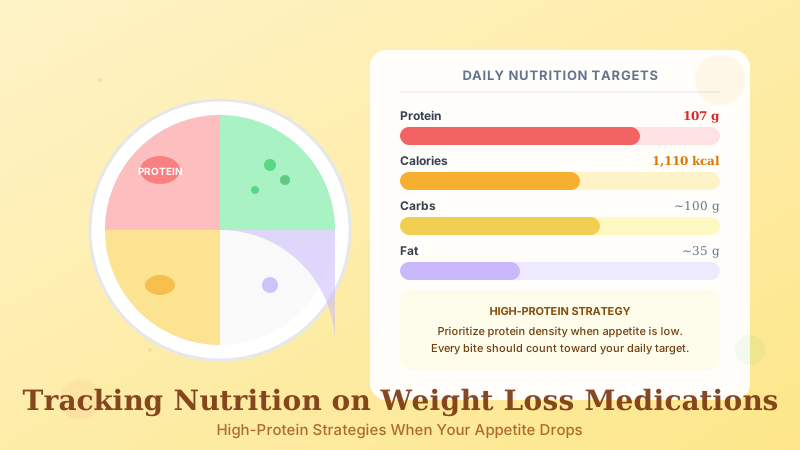
If you are using a GLP-1 or similar weight loss medication — tirzepatide, semaglutide, or another prescription option — one of the most common experiences people report is a dramatic drop in appetite. Many describe it as "not thinking about food anymore" or "finishing a meal and immediately feeling full." This is exactly what these medications are designed to do. But there is a nutritional side effect that does not get as much attention: when your appetite shrinks, your protein intake can shrink with it.
That matters because rapid weight loss already increases the risk of muscle loss, and inadequate protein makes that risk worse. The good news is that this is something you can plan for — even (and especially) when you are eating much less than usual.
This article walks you through practical strategies for maintaining adequate protein intake when your appetite is reduced, and shows you how to use our Calorie Calculator and related nutrition tools to build a plan that works with your actual eating capacity, not against it.
Disclaimer: This article discusses nutrition planning tools and general dietary strategies. It does not constitute medical advice. All questions related to medication use — including whether to use medication, dosing, side effects, or drug interactions — should be discussed with your doctor or pharmacist.
Why Protein Matters More When Appetite Drops
When you eat less overall, every bite needs to work harder. This is the concept of "nutrient density" — getting the most nutrition out of the smallest volume of food. Protein is the priority nutrient in this context for two reasons:
-
Muscle preservation during weight loss. Rapid weight loss causes the body to break down tissue for energy. Without adequate protein, a significant portion of that breakdown comes from muscle rather than fat. Research suggests that people losing weight benefit from higher protein intakes — around 1.2 to 1.6 grams per kilogram of body weight per day — compared to the minimum 0.8 g/kg recommended for sedentary adults.
-
Satiety signal. Protein is the most satiating macronutrient. Eating protein-dense foods at each meal helps maintain the feeling of fullness, which can make sticking to a reduced eating pattern more sustainable.
The challenge for someone with a suppressed appetite is simple: if you can only finish half of what you used to eat, how do you still hit your protein target?
Strategy 1: Prioritize High-Protein, Low-Volume Foods
When you cannot eat large portions, choose foods that deliver the most protein per bite. Here are some of the most efficient options:
- Greek yogurt (nonfat, plain): ~10 g protein per 100 g, very little volume, easy to eat cold
- Chicken breast: ~31 g protein per 100 g cooked, lean and compact
- Protein powder/shakes: ~20–25 g protein per scoop mixed with water or milk, virtually zero volume
- Cottage cheese: ~11 g protein per 100 g, soft and easy to swallow
- Egg whites: ~3.6 g protein per large egg white, minimal calories and volume
- Tuna or canned salmon: ~25 g protein per 100 g, no cooking required
The key principle is "every bite counts." When your total food volume is limited, snacks like chips, crackers, or sugary drinks become expensive in terms of calories but cheap in terms of nutrition. Opt for protein-forward choices even for snacks.
Strategy 2: Eat Smaller, More Frequent Meals
Many people find that three standard-sized meals feel impossible when appetite is low. Switching to five or six tiny meals or snacks can be more manageable. Instead of sitting down to a full plate, graze throughout the day on small protein-rich items: a handful of almonds, a string cheese, a hard-boiled egg, a small cup of Greek yogurt.
This approach also has a practical advantage for calorie tracking: you can log each small eating occasion separately and still see your daily totals clearly. The math does not change — your total protein and calories are the same regardless of how many meals they come in — but the psychological and physical experience is often easier.
Strategy 3: Use Liquid Calories Strategically
Liquid nutrition is one of the most practical strategies when solid food feels overwhelming. A protein shake made with whey protein, a splash of milk, and frozen berries can deliver 30–40 grams of protein in under 300 calories, all in a single glass. Smoothies with Greek yogurt, protein powder, and spinach are another option that combines protein with micronutrients in a form that is easy to consume.
The Calorie Calculator can help you estimate how many of these shakes fit into your daily targets without pushing you past your calorie budget.
How to Calculate Your Adjusted Targets
Here is where our tools come in. Even though your appetite has changed, the fundamental calculation does not: you still need to know your Basal Metabolic Rate (BMR), your Total Daily Energy Expenditure (TDEE), and an appropriate calorie deficit based on your weight loss goals.
Step 1: Find Your Baseline Numbers
Use the Calorie Calculator to determine:
- Your BMR — the calories your body burns at rest
- Your TDEE — your maintenance calories based on activity level
- Your target calories for safe weight loss (typically TDEE minus 300–500 kcal)
- Your macronutrient breakdown, including the recommended protein intake
These numbers represent your starting point. They do not change just because your appetite has dropped — what changes is how you meet those targets within a smaller eating volume.
Step 2: Map Your Targets to Realistic Eating Patterns
Once you know your calorie and protein targets, ask yourself honestly: "Given my current appetite, can I realistically eat enough to hit these numbers?" If the answer is no, you have a few options:
- Adjust your deficit. If you are struggling to meet protein targets at a 500-kcal deficit, try a gentler 250-kcal deficit instead. Slower weight loss means less muscle loss pressure.
- Focus on protein first, calories second. Hit your protein target even if it means eating slightly above your calorie goal. Preserving muscle is more important than hitting an exact calorie number.
- Lean on liquid nutrition. As discussed above, shakes and smoothies can fill the gap between what you want to eat and what your body needs.
Step 3: Plan Meals Around Your Actual Capacity
If you can only eat 800–1,000 calories per day right now, that is fine. Use our calorie meal plan articles as reference points. For example:
- The 1,500 Calorie Meal Plan includes recipes like Grilled Chicken Quinoa Bowl (~53 g protein) and Overnight Oats with Greek Yogurt (~37 g protein) — both are compact, protein-dense meals that work well when appetite is low
- The 1,800 Calorie Meal Plan and 2,000 Calorie Meal Plan offer similar high-protein recipes at larger portions
You do not need to follow any of these plans exactly. Use them as building blocks: pick the recipes and portions that match what you can actually eat today, and adjust from there.
A Sample "Low Appetite" Day
Here is what a realistic day might look like for someone eating approximately 1,000–1,200 calories with a protein target of 70–80 grams:
| Time | What | Approx. Calories | Protein |
|---|---|---|---|
| Morning | Protein shake (1 scoop whey + 250 ml milk + banana) | ~320 kcal | ~30 g |
| Mid-morning | Small cup of Greek yogurt (150 g) | ~100 kcal | ~15 g |
| Lunch | Half of the Grilled Chicken Quinoa Bowl recipe (0.5×) | ~240 kcal | ~26 g |
| Afternoon | 2 hard-boiled eggs | ~140 kcal | ~12 g |
| Dinner | Half of the Overnight Oats recipe (0.65×) | ~241 kcal | ~18.3 g |
| Total | ~1,041 kcal | ~101 g |
This is intentionally flexible. Some days you might manage more food; some days less. The point is to show that even at a reduced intake level, hitting your protein target is achievable with strategic food choices and a bit of planning.
What to Track (and What Not To)
When you are adjusting to a new relationship with food, tracking can be helpful — or it can become a source of stress. Here is a balanced approach:
Track:
- Daily protein intake (this is the single most important metric during weight loss on reduced appetite)
- Weekly average weight (not daily fluctuations)
- General energy levels and hunger patterns
Do not obsess over:
- Hitting your calorie target to the exact number. If you consistently fall below, that accelerates weight loss but may increase muscle loss. If you consistently exceed it slightly, that is fine as long as protein is adequate.
- Perfect macro splits. A day with slightly more carbs or fat than planned is not a failure — especially when the alternative is not eating at all.
- Individual meal-by-meal accuracy. Focus on the daily total.
When to Talk to Your Healthcare Provider
There are situations where reduced appetite and low food intake warrant a conversation with your doctor or a registered dietitian:
- You are consistently eating fewer than 800–1,000 calories per day for more than a few days
- You notice signs of nutrient deficiency (fatigue, hair loss, brittle nails, frequent illness)
- Your weight loss is extremely rapid (more than 1 kg per week) and you are concerned about muscle loss
- You are experiencing nausea, vomiting, or other gastrointestinal symptoms that make eating difficult
Your prescribing clinician can help you navigate these issues in the context of your overall health and treatment plan.
Next Steps
The most important thing you can do right now is get personalized numbers. Every person's caloric needs are different — they depend on your height, weight, age, sex, and activity level. A 1,500-calorie target that works for one person might be far too much (or too little) for another.
Start with the Calorie Calculator to find your BMR, TDEE, and a protein target tailored to your body. Then use those numbers to guide your food choices, even (and especially) when your appetite doesn't match your goals.
Calculate your personalized calorie and protein targets →
This article is for informational purposes only and does not constitute medical advice. All questions related to medication use — including whether to use medication, dosing, side effects, or drug interactions — should be discussed with your doctor or pharmacist.